Sorcery accusation-related violence and the shadow of trauma: A compound threat to Bougainville’s peace

Sorcery accusation-related violence (SARV) is a serious threat to peace, security and human rights in Bougainville. In March 2026, the Bougainville Executive Council took decisive steps to affirm that sorcery may be a customary belief, but violence is a crime. This article examines Bougainville’s new whole-of-government response, early implementation efforts and the lessons emerging for communities, governments and partners across Melanesia
by Dennis Kuiai
Introduction
Sorcery accusation-related violence (SARV) has emerged as one of the most pressing threats to peace, security and human rights in Bougainville. Rooted in customary beliefs yet manifesting as criminal acts of torture, murder and displacement, SARV destabilises communities and undermines Bougainville’s journey towards independence.
Historically, sorcery accusations were mediated through customary processes of confirmation, restitution and reconciliation, which reinforced cohesion and restored balance within clans. In recent decades, however, these processes have eroded, replaced by fear-driven violence and mob justice. The absence of a coherent government-led response has left vulnerable groups, particularly women, widows, children, the elderly, and persons with disabilities, exposed to grave risks.
Recent forums convened by the Bougainville Law and Justice Coordinating Mechanism have underscored the urgency of addressing SARV through comprehensive prevention and response strategies. These strategies must align with Bougainville Vision 2052, integrating governance, protection, education, justice and community-led solutions.
Addressing SARV is not merely a matter of law enforcement; it is a moral imperative tied to Bougainville’s stability, sovereignty and commitment to human dignity.
A compound threat to Bougainville’s peace and security
SARV is defined as violence, including torture, assault and murder, against individuals accused of sorcery. It disproportionately affects marginalised groups, stripping families of livelihoods, displacing entire households and leaving lasting psychological and physical scars.
Research conducted in 2019 documented 266 cases across five locations, including 12 deaths, though the true scale is far greater.[1] In 2025, the Bougainville Law and Justice Coordinating Mechanism affirmed unequivocally that SARV is not custom but crime, calling for urgent, coordinated strategies to safeguard Bougainville’s future.
The persistence of SARV is compounded by drug and alcohol abuse and mental health challenges, which intensify the cycle of violence. Substance abuse fuels impulsive aggression, erodes community resilience, and magnifies the likelihood of mob violence. Mental health issues, many rooted in conflict trauma, displacement, and poverty, leave individuals vulnerable to fear-driven scapegoating. Together, these forces create a vicious cycle: SARV generates trauma, trauma drives substance abuse and mental instability, and these in turn escalate further violence.
Thus, SARV is not merely a cultural or legal issue; it is a multi-dimensional public health, governance, and peacebuilding challenge. Addressing it requires integrated strategies that combine law enforcement, community education, mental health support, substance abuse rehabilitation, and reconciliation mechanisms.
Bougainville Executive Council decision on SARV
Recognising the destructive impact of SARV on public order, community stability and Bougainville’s independence journey, the Bougainville Executive Council (BEC) considered the issue on 27 March 2026 and issued a series of landmark determinations, outlined below.
Recognition of sorcery in Bougainville
The BEC acknowledged that sorcery has, since time immemorial, been recognised as a customary belief and practice integral to community cohesion and clan leadership.
Historically, sorcery was addressed through lengthy customary processes of confirmation, restitution and reconciliation, reinforcing peace and stability.
Affirmation that SARV is not customary
The BEC affirmed that SARV does not constitute a customary norm and must be understood as criminal conduct. Acts such as accusation, wilful murder, torture, grievous bodily harm, unlawful assembly, riot, and threats of violence are crimes under the law.
Divination and witchcraft practices (glasman/meri) were identified as catalysts of SARV, particularly when used to accuse others of sorcery and those who make or incite such accusations must be held accountable. SARV is therefore a violation of fundamental human rights, a breach of the Bougainville Peace Agreement, and a distortion of legitimate customary processes.
Whole-of-government approach
The BEC adopted a comprehensive framework for intervention:
Permanent parliamentary committee – Establishment of a Committee on SARV and Customary Beliefs to provide oversight, guidance, and legislative support.
Rapid response strategy – Formal adoption of the Rapid Response SARV Strategy as the immediate framework for government intervention.
Immediate implementation – Execution of the SARV Response Strategy across all agencies, institutions, and Community Governments.
Integration of customary processes – Support for peaceful customary sorcery confirmation and reconciliation mechanisms consistent with the Bougainville Peace Agreement.
Application of legal instruments – Enforcement of the PNG Glasman/Meri Act and the Criminal Code by the Bougainville Police Service and courts to ensure accountability.
Procedural guidelines for customary mediation
Community Court officials, chiefs and community leaders were directed to adhere strictly to the Customary Sorcery Resolution Process. Safeguards include victim protection, prevention of mob violence and immediate referral to police if violence occurs. Decisions made without full customary compliance are invalid.
Required actions
All Departments, Divisions, District Administrations and Community Governments were instructed to integrate SARV prevention into work plans, nominate focal officers, conduct awareness campaigns, maintain SARV registers and report regularly to the BEC.
Through this resolution, Bougainville declared unequivocally: sorcery may be a belief, but violence is a crime. Ending SARV is essential to protect life, uphold justice, and preserve peace in Bougainville.
Implementation progress: May 2026
By mid-May 2026, the Autonomous Bougainville Government (ABG) began formal implementation of its landmark decision on SARV. The process commenced with the convening of key stakeholders, bringing together service providers, the Bougainville Police Service, peacebuilders, health professionals and representatives from the justice sector. This multi-sectoral gathering marked the first coordinated step toward operationalising the Rapid Response SARV Strategy.
One of the earliest outcomes was the establishment of Regional Response Teams, designed to provide structured mechanisms for immediate intervention at the community level. These teams linked local leadership, police and service providers to ensure timely protection of victims and accused persons, while reinforcing the principle that SARV is not custom but crime.
To build capacity and ensure consistency across districts, stakeholders agreed to conduct a Training of Trainers (ToT) program. This initiative aimed to deepen understanding of SARV, clarify referral pathways and equip frontline actors with the skills neeed to intervene effectively and safely. The Melanesian Institute (MI), recognised for its expertise in research and community engagement, particularly its Pastoral Approach to sorcery-related issues, was formally invited to lead the training.
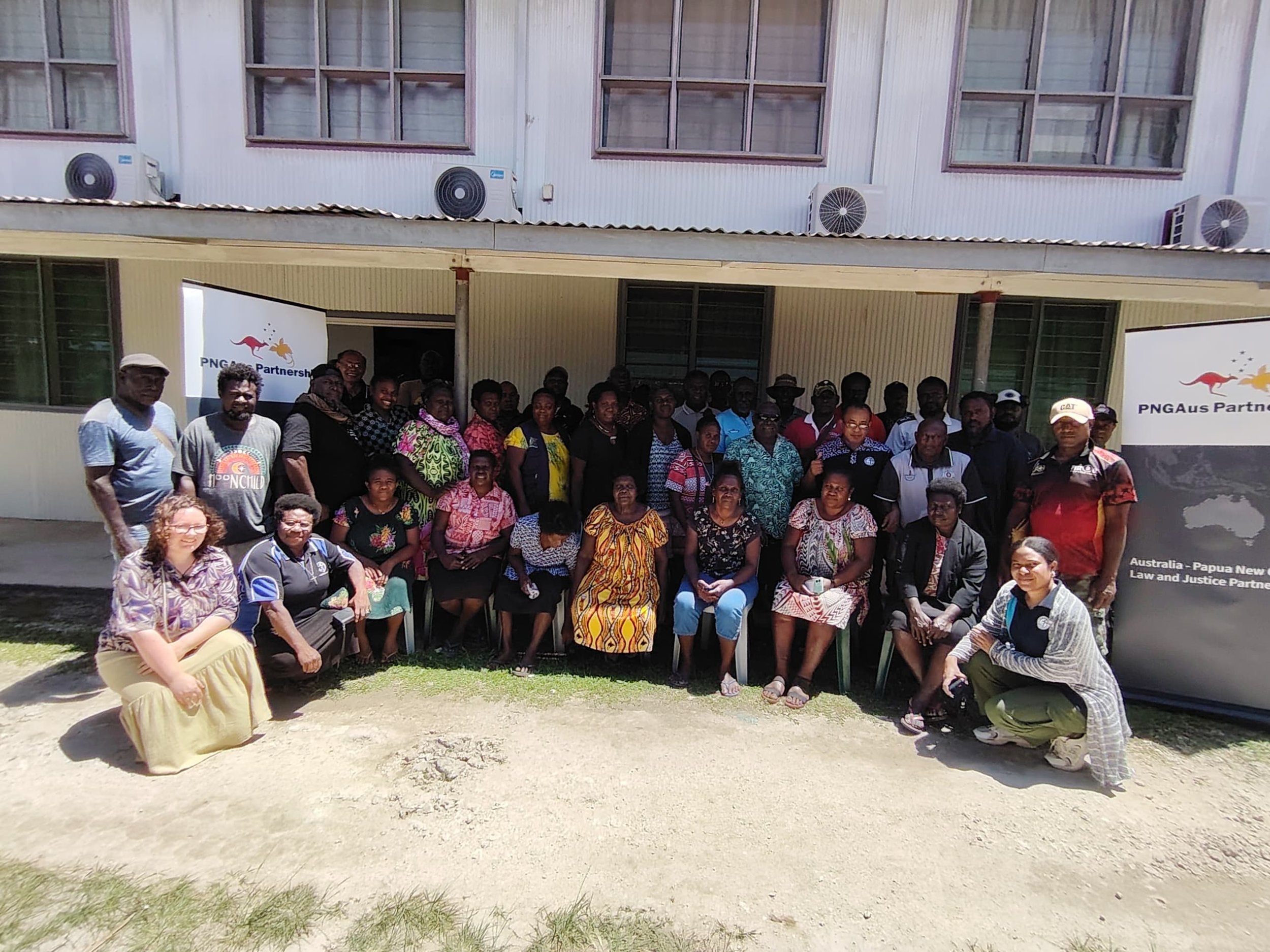
SARV Training of Trainers group photo.
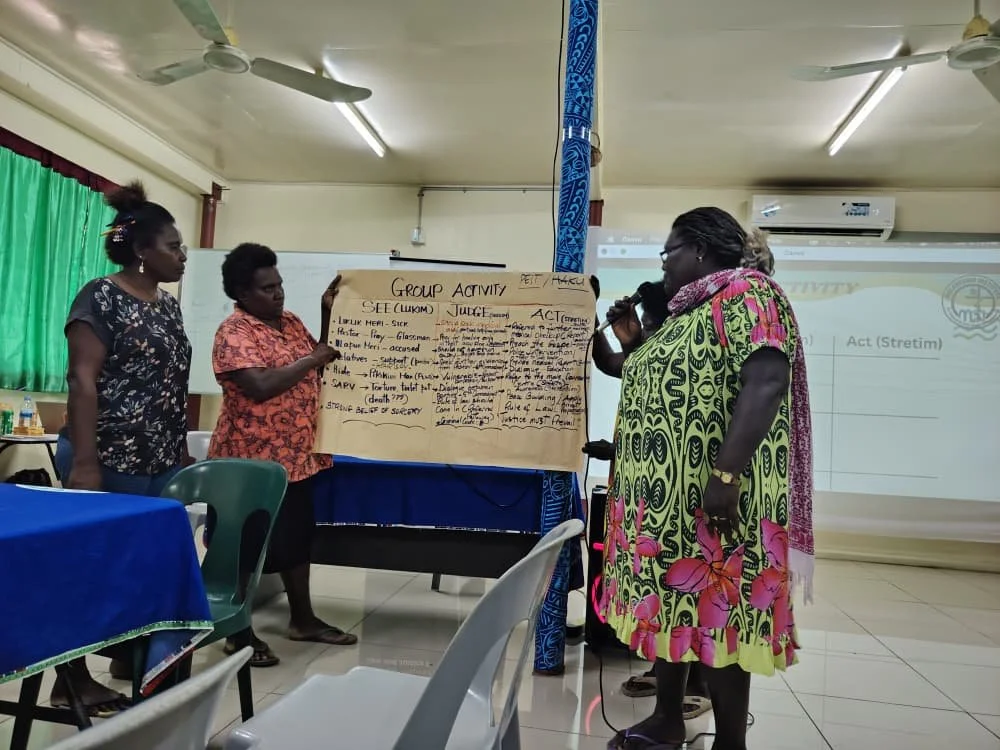
MI pastoral approach activity during Training of Trainers session.
The commencement of these activities signalled a decisive shift from policy formulation to practical action. It demonstrated Bougainville’s commitment to embedding SARV prevention and response capacities within its governance structures, while drawing on customary leadership and external expertise. The May 2026 rollout thus marked the beginning of a coordinated, whole-of-government and community-led effort to confront SARV, protect vulnerable groups and safeguard Bougainville’s peace and independence journey.
Lessons for Melanesian societies and partners
Bougainville’s experience demonstrates that SARV is not simply a cultural matter, but a profound challenge of governance, justice and human rights.
The lesson for Melanesian societies and international partners is clear: no single institution can confront SARV alone. It requires an all-of-society approach: government, chiefs, churches, civil society and communities working together in collective responsibility.
Key takeaways include:
Respect belief, reject violence – Customary beliefs may remain part of identity, but violence must be treated as a crime.
Inclusive governance – Chiefs, churches, women, youth and government institutions must share responsibility for prevention and response.
Community protection – Local response teams, safe houses, and referral pathways are essential to safeguard victims.
Justice and accountability – Formal prosecution must be strengthened, complemented by peaceful customary reconciliation.
Education and training – Awareness campaigns and Training of Trainers programs build local capacity and reduce fear-driven violence.
Global alignment – Linking local strategies to national laws and international human rights standards strengthens legitimacy and mobilises support.
Bougainville’s approach underscores that SARV is a test of collective will. Only through unity of leadership, institutions and communities can victims be protected, perpetrators held accountable and peace sustained across Melanesia.
Conclusion
SARV represents a compound threat to Bougainville’s peace, exacerbated by drug and alcohol abuse and untreated trauma. It destabilises communities, undermines customary authority and jeopardises Bougainville’s journey towards independence. Bougainville’s Executive Council has taken decisive steps to affirm that SARV is crime, not custom, and to embed prevention and response mechanisms across governance structures.
The lessons from Bougainville are clear: confronting SARV requires an integrated, all-of-society approach that combines law enforcement, education, mental health support, substance abuse rehabilitation and reconciliation. For Melanesian societies and international partners, Bougainville’s experience offers a model of resilience and collective responsibility.
The BEC’s determinations provide an important basis for this work, but their implementation will be critical. In particular, preventing harmful accusations, holding those responsible accountable and protecting people from violence will require sustained action across Bougainville’s governance and community structures. Ending SARV is essential for Bougainville’s stability and sovereignty, making it a moral imperative for protecting human dignity across the region.
Notes
[1] Miranda Forsyth and Llane Munau, Report on Sorcery Accusation Related Violence in Bougainville for the Autonomous Bougainville Government (2019) https://researchportalplus.anu.edu.au/en/publications/report-on-sorcery-accusation-related-violence-in-bougainville-for/
References
BEC Decision Number 22 of 2026.
Braithwaite, J., & D’Costa, B. (2018). Cascades of violence: War, crime and peacebuilding across South Asia. Canberra: Australian National University Press. (Provides a theoretical framework on cascades of violence, applied in Forsyth’s Bougainville study.)
Forsyth, M. (2019). Kill all the sorcerers: The interconnections between sorcery, violence, war and peace in Bougainville. British Journal of Criminology, 59(4), 842–861. https://doi.org/10.1093/bjc/azy047 (doi.org in Bing)
Human Rights Watch. (2015). Papua New Guinea: Sorcery-related killings and impunity. New York: Human Rights Watch. (Highlights human rights dimensions and international obligations.)
Melanesian Institute. (2015). Sorcery accusation-related violence in Papua New Guinea: Frameworks for prevention and response. Goroka: Melanesian Institute. (Community-based pastoral approach, relevant to Bougainville’s ToT training.)
Papua New Guinea Constitutional and Law Reform Commission. (2013). Review of the law relating to sorcery and sorcery-related killings in Papua New Guinea. Port Moresby: CLRC. (Key national-level policy document following repeal of the Sorcery Act 1971.)
United Nations Office of the High Commissioner for Human Rights. (2016). Report on sorcery accusation-related violence in Papua New Guinea. Geneva: OHCHR. (Links SARV to international human rights standards, relevant for Bougainville’s obligations.)