Justice for Witches: Grant a Royal Pardon for historic British witches
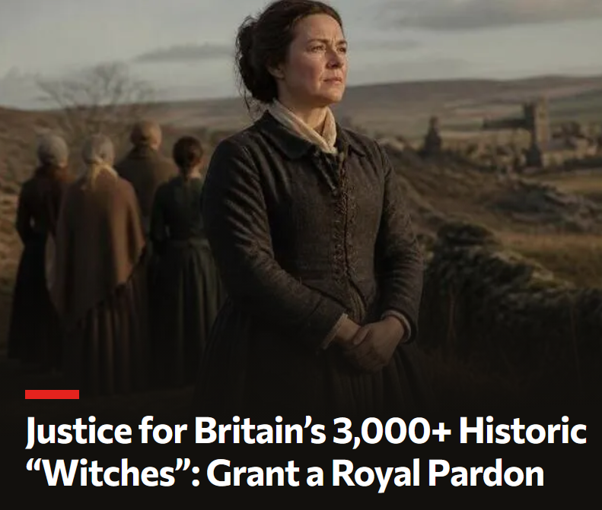
An impossible crime. Over 3,000 innocent lives. Centuries of unjust criminal records.
The Justice for Witches campaign is seeking an official Royal Pardon to clear the names of those convicted under Britain’s historic witchcraft laws - and to take a stand against misogyny and human rights abuse today.
by Charlotte Meredith
The Justice for Witches campaign began in 2023 with one clear objective: to secure posthumous pardons for the estimated 3,000 people convicted in Great Britain under unjust witchcraft legislation between 1542 and 1735.
A brief history of the British witch trials
By order of King Henry VIII, the first English Witchcraft Act was created in 1542. Prior to this date, accusations of witchcraft had been dealt with by the Church, but now the secular court took over, and anyone found guilty of using ‘witchcrafts, enchantments, and sorceries to the destruction of their neighbour’s person and goods’ (1) could receive the death penalty.
When King James I was crowned the King of England, Wales and Scotland, he amended witchcraft legislation in 1604 to reflect his own beliefs about ‘witches’. While the connotation had always been that witches were people who used demonic magic to cause harm, now the belief that the witch was an individual who had made a pact with the Devil was written into British law. (2)
King James was a firm believer in what scholars term the elaborated theory of witchcraft: the wild conspiracy theory popular in Continental Europe that a newly-formed, female-led group of sabbat-attending devil-worshippers had made a covenant with the Devil and were intent on overthrowing Christendom.
The British Witchcraft Acts were repealed in 1735. From 24 June, it now became a crime punishable by means of a fine or a period of imprisonment for a person to ‘pretend to exercise or use any kind of witchcraft, sorcery or enchantment or conjuration, or undertake to tell fortunes’. (3) The significant difference here was that the new law made it clear that witchcraft was a fraudulent activity and not a reality.
We are halfway there:
In response to our 2023/24 petition, the UK government agreed that the Georgian Parliament ‘repealed laws against witchcraft through the Witchcraft Act of 1735, recognising that witchcraft was an impossible crime’. (4) Justice for Witches has consistently argued that those convicted under the earlier Witchcraft Acts should have had their names cleared when the legislation was repealed.
The principle is simple: a person cannot be guilty of a crime that was never real. Given the Government's position on why the legislation was repealed, it can no longer be considered fair or just to continue to regard these individuals as criminals.
There were no witches. There was no crime.
We will therefore continue to campaign for real justice for those convicted for offences of witchcraft.
The Royal Prerogative of Mercy:
Exoneration for the 3,000-plus individuals convicted of a make-believe crime is sadly not an option in Great Britain today. However, a Royal Pardon granted by His Majesty King Charles III is our best chance of reparative justice and will be analogous to clearing their names by being effected as formal acknowledgement that the prosecutions and convictions should never have happened in the first place.
In modern law, the purpose of a free pardon is to remove ‘all pains, penalties and punishments whatsoever that from the said conviction may ensue’. (5)
We request the Royal Pardon be effected to remove the following pain or consequence of the convictions: defamation of character. These innocent people should no longer be demonised.
Why justice for historic British witches matters today:
Supporters of INAWARA recognise that witch trials are not a thing of the past, but it’s fair to say that this fact is not well-known in the Western world. The belief in maleficium — using demonic magic to cause harm to a person or their goods — is a harmful belief that still exists and is used as justification for the abuse of individuals today in many countries, including Great Britain.
By granting a Royal Pardon to Britain’s historic witches, the British government has an opportunity to send a powerful message: witchcraft-related abuse is a violation of human rights and has no place in modern society or the Commonwealth.
A Royal Pardon would do more than acknowledge the injustices of the past. By shining a spotlight on historic persecution it could help protect victims today — raising awareness, encouraging victims and witnesses to report abuse, and making clear to potential perpetrators that witchcraft-related abuse will not be tolerated and that those responsible must be held accountable.
Please show support for Justice for Witches by signing and sharing our petition today. In doing so, you are standing up for all victims of witchcraft-belief-related persecution, both past and present and helping to bring an end to witch trials.
References:
1) https://statutes.org.uk/site/the-statutes/sixteenth-century/1541-33-henry-8-c8-witchcraft/
3) https://statutes.org.uk/site/the-statutes/eighteenth-century/1735-9-george-2-c-5-the-witchcraft-act/
4) https://petition.parliament.uk/archived/petitions/640686
5) https://www.scribd.com/document/824578883/R-v-Foster-1984-2-All-ER-679