The invisible mosaic: Mapping the global response to HPAWR
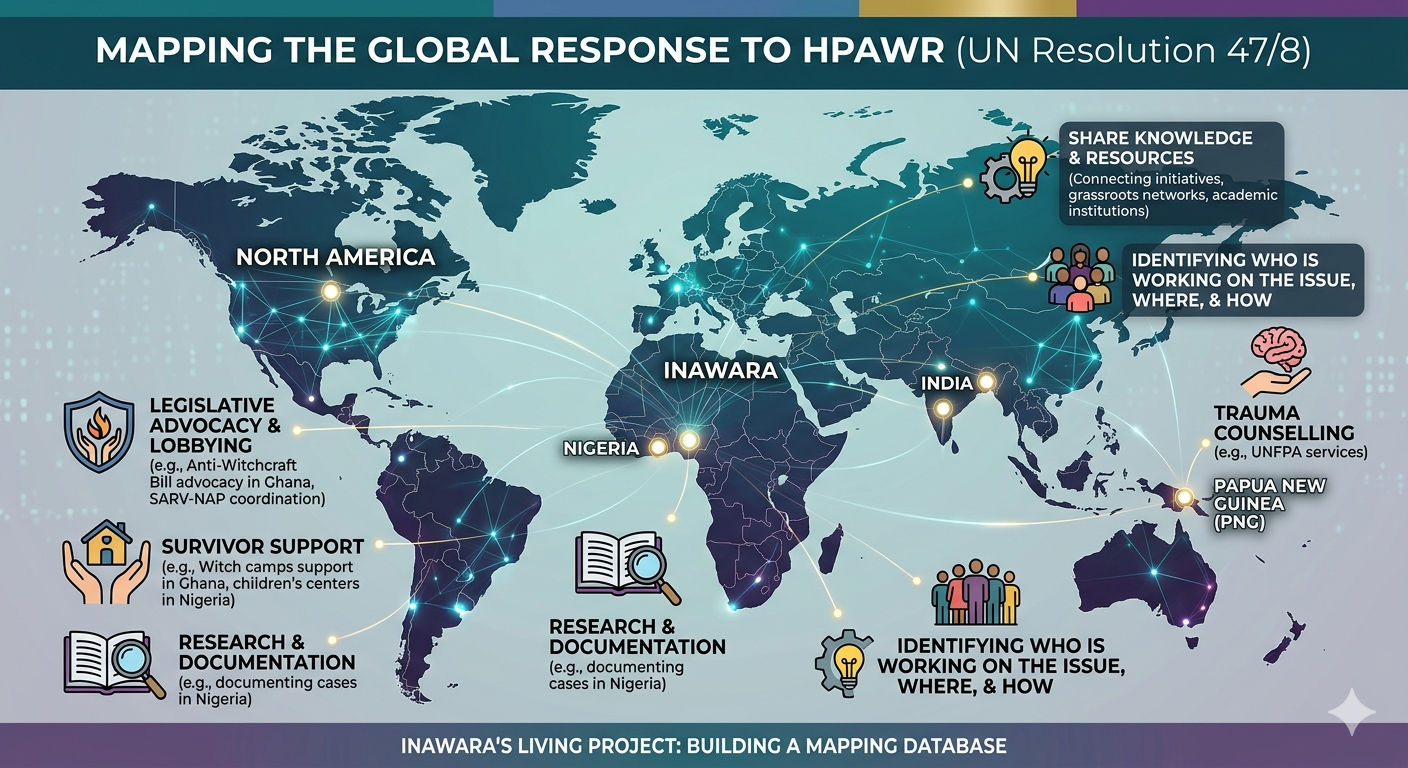
INAWARA intern Marissa Brinkley takes us into the critical work of mapping a global human rights crisis. In this post, she explores the reality of modern-day witchcraft accusations and ritual attacks (HPAWR), highlighting how data and connection are being used to protect survivors and advocate for legislative change across the globe.
by Marissa Brinkley
It wasn’t until recently that I became aware of the reality of modern-day witch hunts. In the 21st century, harmful practices related to accusations of witchcraft and ritual attacks (HPAWR, UN Resolution 47/8) continue to trigger human rights violations. These are not isolated incidents, but grave abuses, ranging from banishment to violence and killings.
The Current Landscape
One of INAWARA’s goals is to connect individuals, organizations, and initiatives working on HPAWR in different countries and regions. As part of this, we have been building a mapping database to identify who is working on this issue, where, and how. So far, this includes organizations from Papua New Guinea (PNG), Nigeria, Ghana, North America, India, and beyond. This database is our attempt to bring that activity together in one place, so people working in this space can find each other, share knowledge, and learn from what others are doing.
The range of work already happening is significant. Here are some examples of what we have mapped so far from PNG, Nigeria, and Ghana:
Legislative Advocacy and Lobbying: In Ghana, a coalition of national and international organizations partnered with Ghana’s Parliamentary Select Committee on Human Rights for a series of visits to witch camps, directly advocating for survivor-based legislation. Amnesty International’s report “Branded For Life” documents how witchcraft accusations are leading to serious human rights violations for many in northern Ghana, and is actively calling on the President to sign the Anti-Witchcraft Bill into law. In PNG, Stop Sorcery Violence has developed a national action plan, the SARV-NAP, to coordinate legislative and policy responses to HPAWR.
Survivor Support: The Witch-Hunts Victim Empowerment Project, working in Ghana, sends social workers to visit women living in witch camps, providing food, essential items, and assistance with health, legal, and other needs. In Nigeria, Land of Hope runs a children’s center offering shelter and care for children who have been accused of witchcraft, and the Children’s Rights and Rehabilitation Network works on the de-stigmatization of these children to support their reintegration into their communities. In PNG, United Nations Population Fund (UNFPA) PNG is scaling up trauma counselling and long-term mental health services for survivors and their families.
Research and Documentation: In Nigeria, Safe Child Africa has recorded over 2,400 cases of child abuse inclusive of witchcraft accusations while Advocacy for Alleged Witches estimates over 15,000 children in Akwa Ibom and Cross River State alone have been branded as witches. UNFPA PNG has also published multiple resources across HPAWR, contributing to a growing body of evidence on the issue.
A Living Project
These examples are just a small part of what the map contains. The full picture spans many more countries and organizations, from academic institutions and legal bodies to grassroots networks and individual advocates. This mapping is ongoing, and we are continuing to learn from each new connection we make.
If you know of any organizations, initiatives, or individuals working to address HPAWR, we would love to hear from you. Please get in touch and help us build a more complete picture of the global response to this issue.
Contact us at: https://www.theinternationalnetwork.org/contact
Acknowledgements: Image created from prompt using Gemini.